

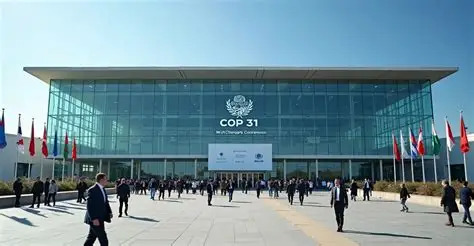
For millions of communities still waiting for reliable energy, resilient cities, secure food systems and investment that reaches the ground, another climate pledge will not be enough.
During the United Nations press conference in June 2026, Murat Kurum, Türkiye’s Minister of Environment and Urban Planning and COP31 President-Designate, said, “The time for simply setting out goals is behind us.”
Kurum insisted that the task before us now is to “accelerate implementation” of pledges and commitments. While his statement sounds bold and breathes enthusiasm, it is not new.
COP30 in Belém had the same tone. However, vulnerable communities, especially those in the Global South, have not seen the desired change. In Africa, climate pressures continue to expose communities to rising temperatures, water stress, food insecurity and other risks. In Ethiopia, Kenya and Nigeria, rapid climate shifts have made it challenging for communities to meet their daily needs. Cases of acute water shortages have jeopardised agriculture and increased domestic conflicts within communities.
Worse still, coastal nations such as Tanzania, Togo, Senegal, Mozambique and Egypt have experienced increasing sea level rise, threatening urban centres, ports and vital ecosystems such as mangroves and coral reefs. The impact has included erosion, infrastructure damage and lower returns on investments in fishing and tourism. Notably, Intergovernmental Panel on Climate Change (IPCC) identifies Cairo and Alexandria in Egypt among several major African cities exposed to sea level rise, alongside Dar es Salaam, Lagos, Cotonou and Porto-Novo.
The scale of the potential economic damage is equally concerning. The IPCC estimates that, without adaptation, sea level rise and coastal extremes could cause aggregate damages of about US$65 billion to 12 major African coastal cities by 2050 under a medium-emissions scenario. Under a high-emissions scenario, the projected damage rises to US$86.5 billion.
Whereas decision-makers continue to make bold statements and consequential promises, the reality on the ground remains one of unfinished business. For countries already facing floods, droughts, food insecurity and rising economic losses, another roadmap or implementation framework will not be enough.
The credibility of COP31 will therefore depend not simply on producing a stronger Action Agenda, but on showing that commitments made at previous COPs are being financed, implemented and felt by people outside the negotiation rooms.
Apart from Kurum, Chris Bowen, Australia’s Minister for Climate Change and Energy and COP31 President of Negotiations, said, “There’s a lot of concern around the world about the geopolitical environment.”
Bowen insisted that “We’re in the middle of the worst energy crisis in our history, and this increases the task for all of us.” In his view, COP31 will “give momentum for the Action Agenda through the negotiations.”
With the same breath, Simon Stiell, the Executive Secretary of UN Climate Change, said, “The global economy is shifting faster than most people think.”
Stiell also said, “The Global Climate Action Agenda can play a vital role.” With a seeming air of optimism, Stiell insisted that the upcoming COP31 negotiations will hopefully bring together governments, companies and investors, cities and regions, civil society, and many more.
This notwithstanding, the guarantee of results remains fluid because, at the end of the day, climate negotiations will depend on how quickly the reality of implementation sinks in.